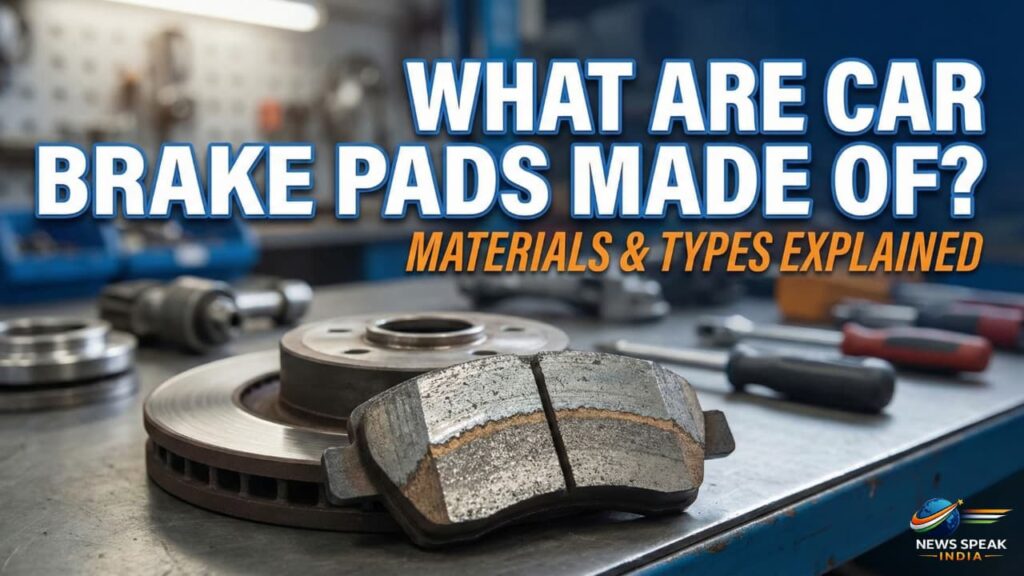
What are Car Brake Pads Made Of? (The 2026 Material Science Guide)
The days of simple “metal on metal” braking are dead. If you’ve peeked at a modern brake pad lately, you aren’t just looking at a slab of material; you are looking at a complex chemical cocktail designed to survive volcanic temperatures while remaining whisper-quiet.
The Quick Material Breakdown
| Pad Type | Primary Materials | Best For | Noise Level |
| Ceramic | Ceramic fibers, non-ferrous fillers | Luxury, daily commuting | Lowest |
| Semi-Metallic | Steel wool, iron powder, graphite | Towing, track days, SUVs | Moderate |
| NAO (Organic) | Rubber, glass, resins, Kevlar | Small cars, light driving | Low |
| Low-Metallic | Organic base + 10-30% metal | High-speed European driving | High |
The Four Core “Compound” Families
The “recipe” for stopping a two-ton vehicle varies wildly depending on your driving style. We categorize these into four main “families” based on their primary friction-producing ingredients.
Non-Asbestos Organic (NAO): The Silent City-Driver Formula
NAO pads were the industry’s answer to the health crisis caused by asbestos. These pads utilize soft materials like rubber, glass, and even Kevlar to provide a gentle “bite.” Because the materials are softer, they exhibit high compressibility, meaning the pedal feels a bit “mushy” compared to race pads, but they are incredibly kind to your rotors.
Insider Tip: If you notice a “burning marshmallow” smell after a long downhill descent, you’ve likely overheated an NAO pad. Their thermal stability is lower than others, leading to “glazing” where the Phenolic Resin seeps to the surface and hardens into a slippery film.
Semi-Metallic: High-Performance Heat Management
This is the workhorse of the automotive world. A Semi-Metallic Compound usually contains 30% to 70% metals, including Steel Wool and iron powder. These materials are excellent at Heat Dissipation, pulling thermal energy away from the calipers and into the atmosphere.
Ceramic Matrix Composites: The Modern Luxury Standard
A Ceramic Matrix Composite uses stacked ceramic fibers and non-ferrous fillers. The goal here isn’t just to stop its cleanliness. The dust produced by these pads is light-colored and non-stick, keeping those expensive alloy wheels looking pristine. They maintain a consistent Mu-Value (coefficient of friction) across a wide range of temperatures.
Low-Metallic NAO: The European Braking Feel
If you drive a BMW or an Audi, you’ve likely noticed your front wheels are perpetually covered in black soot. This is the Low-Metallic NAO at work. They add small amounts of copper or steel to an organic base to improve stopping power at high speeds. It’s a trade-off: world-class safety for a weekly car wash.
The Anatomy of Friction: 5 Hidden Ingredients
To understand what car brake pads are made of, you have to look past the “type” and into the chemistry. Every pad is an alloy of binders, fibers, and lubricants.
Binders (Phenolic Resin): The “Glue” that survives 1,000°F
The Phenolic Resin is the matrix that holds everything together. Under the intense pressure of the Caliper Piston, this resin must not liquefy. If the resin fails, the friction material literally crumbles off the Backing Plate.
Structural Fibers: Why Kevlar and Aramid replaced Asbestos
To give the pad Shear Strength, manufacturers weave in Aramid Fiber or Kevlar. These fibers act like rebar in concrete, preventing the pad from cracking under the massive torque of a high-speed stop.
Friction Modifiers: Using Graphite and Antimony for “Smooth Bite”
It sounds counterintuitive, but brake pads need lubricants. A Graphite Lubricant or Antimony Trisulfide is added to ensure the “bite” is linear. Without these, the brakes would be “grabby,” making smooth stops impossible.
Fillers (Barium Sulfate): Adding density and stability
Barium Sulfate and Zirconium Silicate are used to give the pad mass and thermal bulk. These fillers help the pad maintain its Hardness (Rockwell Scale) even as it wears down to the Wear Indicator.
The Copper-Free Revolution (Leaf Marks Explained)
For decades, Copper Flakes were the “secret sauce” for heat management. However, as brake dust washes into waterways, copper has been found to be toxic to salmon and other aquatic life.
Understanding Level A, B, and N Ratings
Look at the edge of your brake pad box. You’ll see a leaf symbol.
-
One Leaf (Level A): Contains more than 5% copper. (Now largely banned).
-
Two Leaves (Level B): Contains between 0.5% and 5% copper.
-
Three Leaves (Level N): Higher than GHS Compliance; contains less than 0.5% copper.
The Insider Reality: Removing copper was a nightmare for engineers. To replace its heat-wicking properties, they turned to Potassium Titanate and Sintered Metal alloys. If you buy “cheap” pads today, they may lack these expensive substitutes, leading to increased Brake Fade on mountain roads.
Why EV Brake Pads are Chemically Different
Electric Vehicles (EVs) present a unique challenge: they rarely use their mechanical brakes thanks to regenerative braking. This sounds like a win, but it’s a maintenance nightmare.
The struggle with Corrosion and Oxidation
Because the pads sit idle, they don’t get hot enough to burn off moisture. Standard steel backing plates will rot. Modern EV pads now use Galvanized Steel and a Mechanical Retention System (tiny hooks that physically grab the friction material) rather than just Adhesive Bonding.
Case Study: We recently saw a Tesla where the friction material completely de-laminated from the plate. The cause? Hygroscopic Fluid (moisture) got behind the pad, rusted the plate, and “popped” the adhesive. For EVs, always insist on galvanized plates.
The Tribology of a Stop: How Pads and Rotors “Bond”
Braking is not just “rubbing.” It is a chemical exchange known as Tribology.
The Science of the Transfer Layer
When you brake, a microscopic film of the pad material, the Transfer Layer, is cooked onto the rotor. When you step on the pedal, you are actually rubbing “pad material against pad material.” If this layer is uneven, you get “warped rotors” (which is actually just uneven deposit buildup).
Why the Bed-in Process determines the life of your materials
The Bed-in Process is the intentional act of heating the pads to marry them to the rotors. If you skip this, you risk Thermal Scorching, where the surface of the pad becomes brittle and loses its Coefficient of Friction.
Environmental Impact: The Rise of “Clean” Friction
The automotive industry is under fire for Non-Exhaust Emissions. While tailpipe gases are decreasing, Particulate Matter (PM10) from brakes is a growing concern.
Sustainable alternatives: From Cashew Shells to Sintered Metal
Engineers are getting creative. Cashew Nut Shell Liquid (CNSL) is now used as a bio-renewable resin to reduce VOC Emissions. Additionally, for heavy-duty applications like Heavy-Duty Towing, Sintered Metal (fusing metal powders under heat/pressure without melting) is becoming the standard for longevity.
Common Misconceptions
-
“Ceramic pads stop faster than Metallic.” * False. Semi-metallics usually have a higher cold “bite.” Ceramics are for comfort and cleanliness, not necessarily shorter stopping distances in emergency scenarios.
-
“Squealing brakes mean the pads are worn out.” * Not always. Squealing is often just high-frequency vibration. High-quality pads use a Noise-Dampening Shim and a Chamfer (angled edge) to move the vibration outside the range of human hearing.
-
“Slotted Rotors make pads last longer.” * False. Slotted Rotors act like a cheese grater on your pads. They improve performance by venting gases, but they accelerate wear.
Final Scientific Summary
Modern brake pads are a balance of Tribology, environmental law, and mechanical engineering. Whether you are looking for the high Thermal Stability of a Semi-Metallic Compound or the silent performance of a Ceramic Matrix Composite, the chemistry under your wheel arch is more advanced than it has ever been.
Next Step: Would you like me to create a “Brake Pad Comparison Chart” specifically tailored for different vehicle types (SUV vs. EV vs. Sports Car) to help your readers choose the right material?